Guide · Backup power
When SCE cuts power to a foothill circuit on a windy day, a solar system without a battery shuts off with it, by code. A Tesla Powerwall with its gateway disconnects your house from the grid in a fraction of a second, runs the essentials on stored energy, and lets the panels recharge it through the day for as long as the shutoff lasts. It does not make the house immune to outages, and one unit will not run central air all night, but it turns a two-day blackout into an inconvenience instead of a spoiled freezer and a dark house.
Facts checked September 21, 2026
A Public Safety Power Shutoff, or PSPS, is a deliberate outage. When the forecast calls for strong winds, low humidity, and dry fuel in an area Southern California Edison has mapped as high fire risk, SCE de-energizes the circuits there so its own lines cannot start a fire. The power stays off until the weather passes and crews have patrolled the lines, which can mean hours or days.
These are not rare. SCE reports it ran 20 shutoff events in 2024 and 14 in 2025, with more customers affected per event than in earlier years. In August 2026 SCE warned that shutoffs in 2026 could be more frequent, affect more customers, and last longer than usual.
Shutoffs follow SCE's High Fire Risk Area map, which is the wildland edge of the valley, not the flats. In the cities we serve, that means:
We do not claim any specific street has been de-energized unless the city or SCE says so. What the map tells you is whether your circuit is the kind SCE plans to shut off when the wind comes up.
Homeowners with panels are often surprised that the house goes dark with the street. The reason is a safety rule. A grid-tied inverter must shut down the instant it loses utility voltage so it cannot push power back onto lines that crews may be repairing. With no way to separate the house from the grid, the inverter stays off until SCE restores power, even at noon on a clear day.
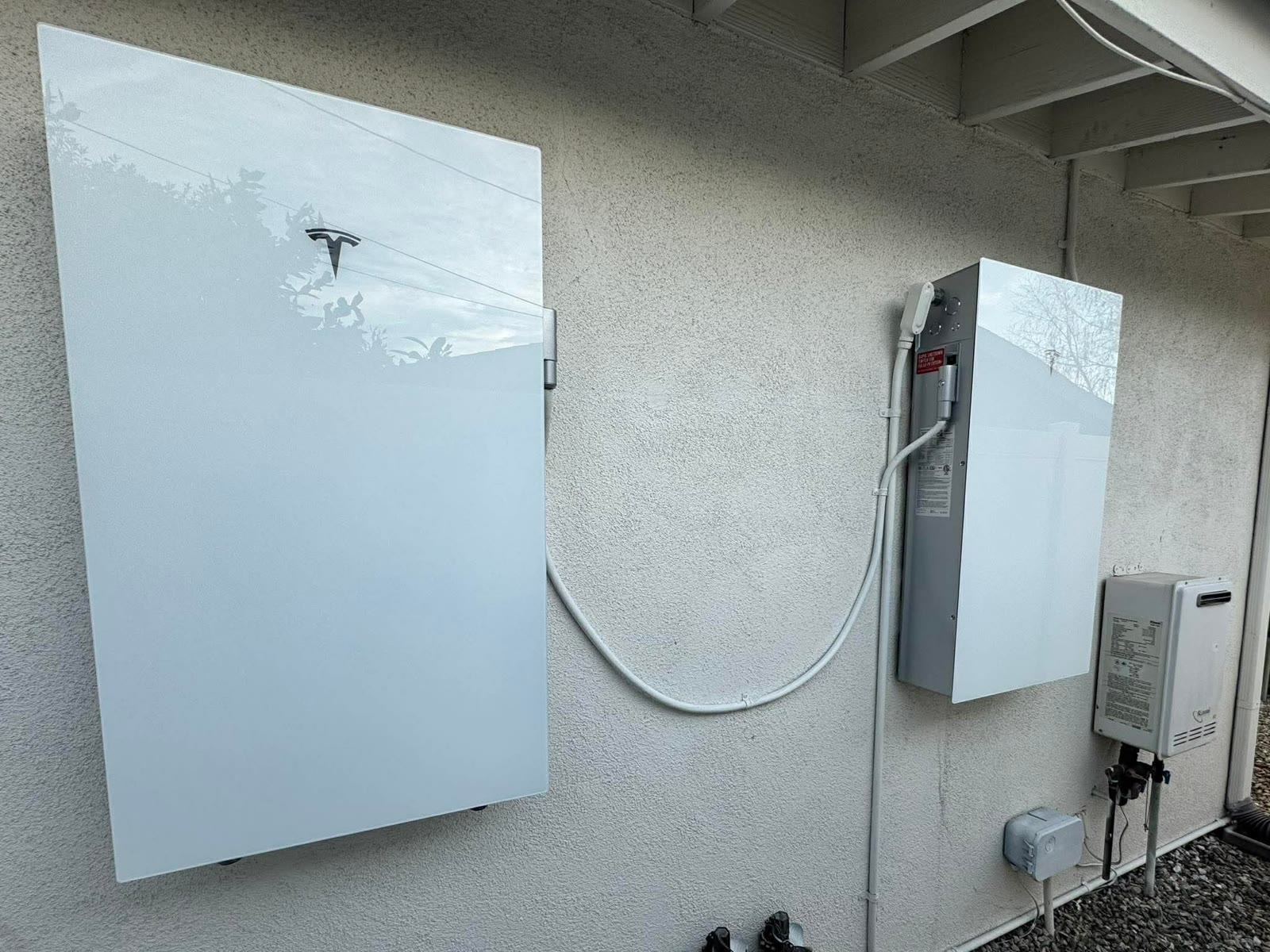
A Tesla Powerwall 3 installs with a gateway that sits between the utility meter and the house. When the gateway senses that grid voltage has failed, it opens the connection to SCE and the Powerwall starts powering the circuits behind it. The changeover happens in a fraction of a second, fast enough that most clocks and routers never reset. The house is now an island.
Because the house is isolated, the solar inverter, which is built into the Powerwall 3, is allowed to run again. Through the day the panels power the home and recharge the battery; at night the battery carries the load. On a sunny week that cycle can repeat for as long as the shutoff lasts. When SCE restores power and the gateway sees stable voltage, it reconnects automatically.
Storm Watch adds one more piece. When the Tesla app receives a severe weather or shutoff alert for your area, the Powerwall charges to full from the grid ahead of time, so you start the outage with a full battery instead of whatever was left after the evening peak.
One Powerwall 3 stores 13.5 kWh and delivers up to 11.5 kW of continuous power. That is enough starting power for most central air conditioners and enough energy to run the essentials for a day or more: refrigerator and freezer, lights, internet and phones, the garage door, a medical device, and a few outlets. Add daytime solar and the essentials can run indefinitely.
What one unit will not do is run central air conditioning all night, an electric range, and a pool pump at the same time. Air conditioning is the biggest single load in a Southern California home, and a battery that has to carry it from sunset to sunrise drains fast. Homeowners who want that level of coverage add a second unit, or we set up the system so the big loads stay off during an outage and everything else keeps working. We say this up front because a battery sold as whole-home backup that is sized for essentials is the most common complaint we hear about other installs.
Most of the cities we serve are covered by Los Angeles County Fire, and the county's rules for lithium batteries shape the installation. The Powerwall goes in the garage or on an exterior wall, never inside living space. Outdoor units keep set distances from property lines and other buildings, from doors, windows, and vents, and from vegetation. Batteries are grouped in blocks of no more than 20 kWh, which for a Powerwall 3 means each unit stands on its own, with space between groups. Diamond Bar and Covina send the battery to county fire for review before the city signs off; West Covina and La Verne run their own fire departments and inspect batteries themselves.
We choose the location during the site visit with the fire rules and the panel location in front of us, so the installation passes the first inspection and the unit is where it can breathe. The Powerwall is rated for outdoor use and Southern California heat.
Azusa Light and Water customers do not face SCE shutoffs, but the utility's interconnection agreement requires any battery to be configured so it never exports power to the grid, directly or by displacing solar output. That is the backup-first, self-consumption mode most homeowners want anyway, and it is how we set up every Powerwall in Azusa.
Tesla, Powerwall, and related marks are trademarks of Tesla, Inc. VertX is an independent company and is not affiliated with or endorsed by Tesla, Inc.
Common questions
Because the electrical code requires it. A grid-tied inverter must stop exporting the moment utility power drops so it cannot energize lines that crews are working on. Without a battery and a transfer device, a solar system has no way to keep the house separated from the grid, so it goes dark with the street. A Powerwall with its gateway is what makes islanding possible.
It depends on what you run. A Tesla Powerwall 3 stores 13.5 kWh and delivers up to 11.5 kW continuous. Essentials such as the refrigerator, lights, internet, garage door, and medical equipment can run for a day or more, and the panels recharge the battery every day the sun is out. Central air conditioning all night is a different load and usually calls for more than one unit. We size to what you actually want protected.
No. Azusa is served by Azusa Light and Water, a city-owned utility, so Southern California Edison shutoffs do not apply inside the city. Azusa homes can still lose power in an ordinary outage or a fire, and Azusa Light and Water requires any battery to be configured so it never exports to the grid, which is exactly how a backup-first Powerwall runs anyway.
Yes. When the gateway senses the grid has dropped, it disconnects the house and the Powerwall picks up the load. The changeover takes a fraction of a second, fast enough that most electronics never notice. When utility power returns and stabilizes, the gateway reconnects on its own.
Usually on an exterior wall near the main panel or in the garage. Los Angeles County Fire, which covers most of the cities we serve, does not allow lithium batteries inside living space, requires clearances from property lines, doors, windows, vents, and vegetation for outdoor units, and limits groupings to 20 kWh with space between groups. We pick the spot on the site visit so it passes the first inspection.